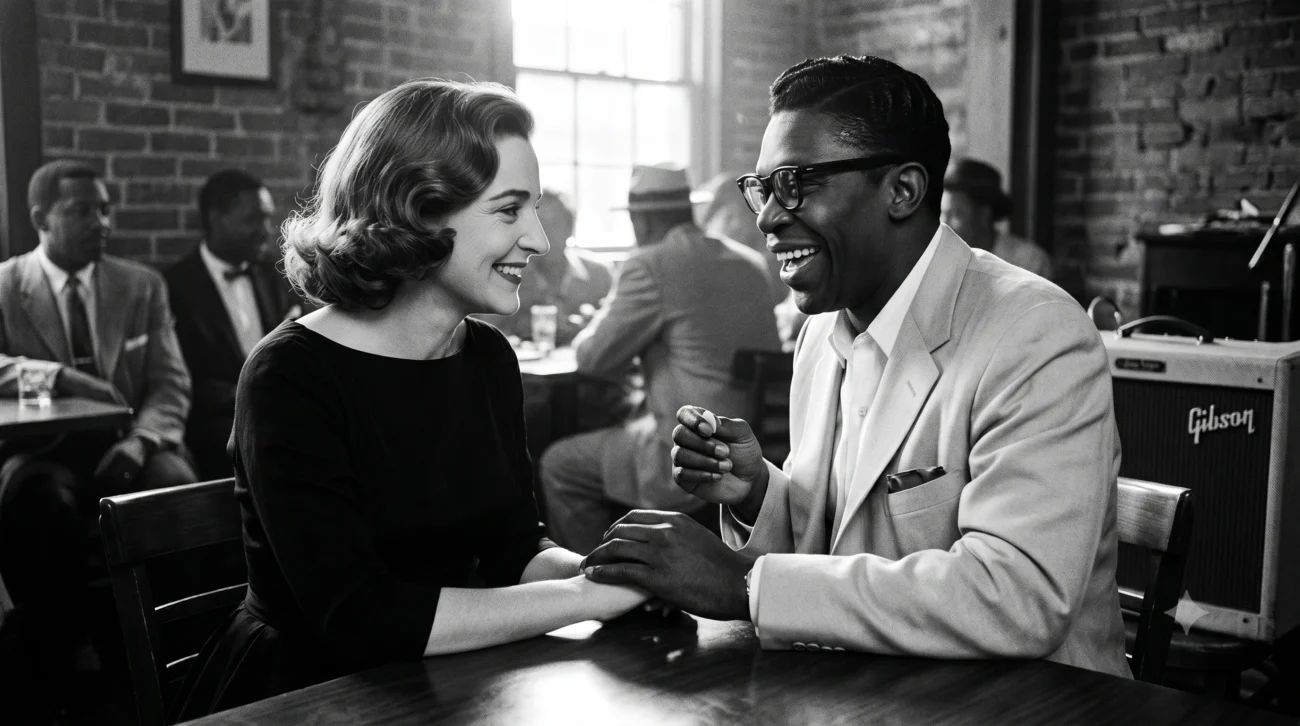
Sue Carol Hall entered public memory through one of the most important figures in American music, but her own story has always been harder to see. She was B.B. King’s second wife, the daughter of Ruby Edwards, and a woman whose name survives in the record because of Club Ebony, the Indianola, Mississippi, venue where blues history and family history met. For readers searching her name, the first honest answer is also the most revealing one: Hall was close to fame, but she did not live as a public celebrity.
That privacy makes her biography different from the usual entertainment profile. There are no major interviews to quote, no public career archive to map, and no verified record of memoirs, media tours, or later public appearances. What remains is a smaller but meaningful paper trail, centered on her family’s place in the Mississippi Delta music world and her eight-year marriage to Riley B. King, the guitarist and singer the world knew as B.B. King.
Early Life and Family Background
The most reliable public information about Sue Carol Hall begins with her mother, Ruby Edwards. Edwards was a businesswoman connected to Black nightlife in Mississippi, including Ruby’s Nite Spot in Leland and Club Ebony in Indianola. The Mississippi Blues Trail says Edwards took over Club Ebony in the mid-1950s and purchased it in 1958, the same year Hall married King. +1
That family connection matters because Club Ebony was not just a room with a stage. It was part of the Chitlin’ Circuit, the network of Black clubs, theaters, and dance halls that sustained performers during segregation. The Smithsonian has described Club Ebony as a prime example of that circuit, a place preserved for its stamped-tin ceiling, recessed lighting, and long connection to Black social life in the Delta.
Hall’s childhood details, schooling, and early ambitions are not well documented in public sources. That absence should not be treated as a mystery to be solved with guesswork. What can be said with confidence is that she came from a family tied to local enterprise, music, and community spaces at a time when Black-owned and Black-serving venues carried deep social importance.
Club Ebony and the World Sue Carol Hall Came From
Club Ebony opened in Indianola in the late 1940s and became one of the Delta’s best-known performance rooms. The Mississippi Encyclopedia traces the club from its earlier identity as Jones Night Spot to its later history under Ruby Edwards, Mary Shepard, and eventually B.B. King. It describes the club as a local home away from home for musicians and residents, a plain building that held outsized cultural weight.
By the time Hall’s name enters the record, B.B. King had already left Mississippi for Memphis and had begun to build a national career. The Mississippi Blues Trail states that King returned to his hometown area in 1955 to perform at Club Ebony, where he met Ruby Edwards’s daughter, Sue Carol Hall. That detail is the firmest public account of how their relationship began.
Not many people know this, but Hall’s family link to Club Ebony places her near an essential part of midcentury American music. This was the world of touring bands, late-night sets, local entrepreneurs, and social spaces that helped keep blues, R&B, and soul alive. Hall was not documented as a performer, but she belonged to a household connected to the work behind the stage.
Meeting B.B. King
When B.B. King met Sue Carol Hall in 1955, he was no longer just a local hopeful. Born Riley B. King in Mississippi in 1925, he had moved through farm work, gospel singing, radio, and Memphis performance circuits before breaking through on the R&B charts. His 1952 hit “3 O’Clock Blues” helped turn him into a major name, and he spent the decade recording, touring, and sharpening the guitar style that later made him a legend. +1
The meeting at Club Ebony was meaningful because Indianola was central to King’s identity. Although he was born near Itta Bena, he long treated Indianola as home, and the B.B. King Museum would later be built there. The New York Times obituary, republished by Legacy, described the museum as a $10 million, 18,000-square-foot structure built around the cotton gin where King once worked.
Hall entered his life during a demanding rise. King was already a working musician with growing obligations, and the rhythm of his career left little room for ordinary domestic stability. Their relationship began not in Hollywood or New York, but in the Delta, inside the network of places that had shaped his sound and his sense of belonging.
Marriage to B.B. King
Sue Carol Hall and B.B. King married in 1958. The Mississippi Blues Trail confirms the year, while Delta Magazine gives a more detailed account, reporting that they married in Detroit in a ceremony presided over by the Rev. C.L. Franklin, the influential minister and father of Aretha Franklin. +1
The marriage came six years after King’s first marriage to Martha Lee Denton ended. Public biographies consistently describe King as having been married twice, first to Denton from 1946 to 1952 and then to Hall from 1958 to 1966. Who2’s profile of King gives the same marriage years and notes that both marriages ended in divorce.
For Hall, marriage meant entering the private side of a career that was becoming almost impossible to contain. King’s work was not a standard job with clear seasons and fixed hours. It was an endless road of clubs, theaters, recording sessions, radio promotion, and travel through a country still marked by segregation and racial hostility.
The Pressure of Life on the Road
B.B. King’s career is often celebrated through the language of endurance, and for good reason. He was famous for touring relentlessly, with accounts noting that he played more than 300 shows in 1956 alone. That drive helped make him one of the defining electric blues musicians of the 20th century, but it also placed heavy pressure on his private relationships.
The failure of King’s marriages has often been linked to that touring schedule. Public summaries of his life regularly say the demands of hundreds of yearly performances strained both marriages, though Hall herself did not leave a large public record explaining the divorce in her own words. The careful phrasing matters because a famous man’s explanation should not be treated as the whole emotional history of a marriage.
That said, the basic shape is clear. Hall was married to a man whose work required constant absence, public attention, and movement through a music business that rewarded stamina more than domestic routine. The same engine that carried King toward wider fame made a settled married life difficult to sustain.
Divorce and Life After the Marriage
Hall and King divorced in 1966. The date is widely repeated in biographical references, and it closes the main period in which Hall appears in the public record. There is no strong evidence of a long public legal battle, a memoir, or a media campaign connected to the end of the marriage.
After the divorce, Hall appears to have chosen privacy. Public sources do not confirm a later public career, remarriage, children, or regular appearances connected to King’s legacy. This is one of the most important facts about her biography because it prevents the story from being inflated beyond the available record.
The truth is, Hall’s life after 1966 cannot be responsibly narrated in detail. Some online profiles fill that space with vague claims about private life, net worth, or later relationships, but those claims are not supported by strong public documentation. A serious biography has to leave that space open rather than turn absence into invention.
Children and Family Questions
Readers often ask whether Sue Carol Hall and B.B. King had children together. The best available public record does not show that they did. King was widely reported to have fathered 15 children, but those children are generally not described as children from either of his marriages.
This distinction matters because King’s family life has sometimes been simplified in online summaries. His children became part of the public story after his death, especially around questions of legacy and estate matters, but Hall is not usually named in reliable accounts as their mother. Treating that carefully protects both Hall’s privacy and the accuracy of the record.
There is also no verified public basis for attaching a detailed family tree to Hall beyond her mother, Ruby Edwards, and the Club Ebony connection. The Mississippi Blues Trail identifies Edwards’s daughter Sue as King’s future wife, and the Ruby’s Nite Spot marker mentions Edwards’s son Terry Keesee. Beyond that, the public record grows thinner.
Career, Money, and Public Profile
Sue Carol Hall was not publicly known for an independent entertainment career. No reliable source identifies her as a recording artist, actor, manager, promoter, or public business figure. Her public profile comes from her marriage to King and from her connection to Ruby Edwards and Club Ebony.
Because of that, claims about Hall’s personal net worth should be treated with caution. There is no credible, well-sourced public estimate of her independent wealth. Any site that assigns a precise figure without documentation is making a claim that serious readers should not accept at face value.
Her mother’s work, by contrast, is much better documented. Ruby Edwards operated important local businesses and helped shape the environment in which Hall and King met. In that sense, the more meaningful economic story around Hall is not celebrity wealth but Black entrepreneurship in Mississippi nightlife during a time when such spaces carried both business and cultural value.
Public Image and Privacy
Sue Carol Hall’s public image is defined by restraint. Unlike some former spouses of famous entertainers, she did not become a regular interview subject or a recurring presence in documentaries, anniversary packages, or celebrity retrospectives. Her name appears in historical markers, short biographies, and accounts of King’s marriages, then largely disappears.
That quietness can be easy to misread. It does not mean her life lacked meaning, and it does not mean she had no agency. It means the public has access to only a narrow portion of her story, and that portion should be handled with respect.
Here’s where it gets interesting. Hall’s privacy gives modern readers a clearer view of how celebrity history is built. Famous men are often surrounded by women whose lives are recorded only through marriage dates, maiden names, and divorce notices, even when those women came from families and communities with stories of their own.
Sue Carol Hall and the Legacy of Club Ebony
Club Ebony outlasted Hall and King’s marriage as a cultural landmark. The club later became closely tied to King’s legacy, and reporting after his death described it as a gathering place for fans and friends. The Associated Press reported that King met Hall there in 1955, that they married in 1958, and that the club later hosted performers including James Brown, Ike Turner, and Bobby Rush.
King eventually purchased Club Ebony, deepening the link between his personal history and the venue. The Mississippi Encyclopedia states that he bought the club in April 2009, while other accounts describe its later connection to the B.B. King Museum.
For Hall, Club Ebony remains the strongest anchor in the record. It gives her biography a place, a family connection, and a cultural setting. Without it, she might appear only as a name in King’s marital history; with it, she becomes part of the wider story of Delta music, Black nightlife, and the community infrastructure that made careers like King’s possible.
Common Confusion About Her Name
Sue Carol Hall is sometimes confused with Sue Carol, the Hollywood actress and talent agent born Evelyn Jean Lederer. That Sue Carol was connected to early film history and married actor Alan Ladd. She was a different person, with a different career, family, and public record.
The confusion is understandable because the names overlap. Search engines often compress people with similar names, especially when one has a fuller entertainment archive than the other. But Sue Carol Hall belongs to the B.B. King, Club Ebony, and Mississippi Delta story.
This distinction is more than a technical correction. Mixing the two women creates false biography, which is unfair to both. A careful profile keeps Hall’s record where it belongs and does not borrow details from another public figure to make her life seem more documented than it is.
Where Sue Carol Hall Is Now
There is no reliable current public information confirming Sue Carol Hall’s present status. Some websites claim to know whether she is alive or dead, but those claims often lack primary documentation. A responsible account should say plainly that her later life has not been publicly established in strong sources.
That may frustrate readers who arrive looking for a full modern update. But privacy is not a gap that journalism has to violate. Unless a person has chosen public life, or unless there is a clear public-interest reason, the absence of current detail should be respected.
What can be said is that Hall’s place in the historical record remains secure through the documented facts of her family, her marriage, and Club Ebony. She was part of the Delta chapter in King’s life before his global image fully hardened into legend. That is enough to make her worth remembering carefully.
Frequently Asked Questions
Who is Sue Carol Hall?
Sue Carol Hall is best known as the second wife of blues legend B.B. King. She was also the daughter of Ruby Edwards, the Mississippi businesswoman associated with Club Ebony in Indianola and Ruby’s Nite Spot in Leland.
How did Sue Carol Hall meet B.B. King?
Sue Carol Hall met B.B. King at Club Ebony in Indianola, Mississippi. The Mississippi Blues Trail says King returned to the area to perform there in 1955 and met Hall, Ruby Edwards’s daughter, during that period.
When were Sue Carol Hall and B.B. King married?
Sue Carol Hall and B.B. King married in 1958 and divorced in 1966. Delta Magazine reports that the wedding took place in Detroit and was officiated by the Rev. C.L. Franklin, father of Aretha Franklin.
Did Sue Carol Hall and B.B. King have children?
Reliable public sources do not show that Sue Carol Hall and B.B. King had children together. King was reported to have fathered 15 children, but those children are not generally described as children from his marriages.
What was Sue Carol Hall’s career?
Sue Carol Hall did not have a documented public career in entertainment, music, or business. Her public recognition comes from her marriage to B.B. King and from her family’s connection to Club Ebony.
What is Sue Carol Hall’s net worth?
There is no credible public estimate of Sue Carol Hall’s personal net worth. Claims that assign her a specific amount without documentation should be treated as unverified.
Is Sue Carol Hall still alive?
There is no strong, current public source confirming Sue Carol Hall’s present status. Because she lived privately after her divorce from King, responsible accounts should avoid unsupported claims about her later life.
Read Also: Edgardo Canales: Lawyer, Marriage, and Biography
Conclusion
Sue Carol Hall’s biography is short in public detail but rich in context. She stood at the crossing of family, music, and fame in the Mississippi Delta, connected to Ruby Edwards, Club Ebony, and B.B. King during a defining period in American blues history.
Her story also reminds us that not every life near celebrity becomes a celebrity life. Hall did not leave behind a large public archive, and she appears to have stepped away from public attention after her marriage ended. That choice deserves the same respect as any public achievement.
What remains is a carefully bounded portrait. Sue Carol Hall was B.B. King’s second wife, Ruby Edwards’s daughter, and part of the Club Ebony story that still echoes through blues history. Her name matters because it points back to the private lives and local places that helped shape a national sound.
