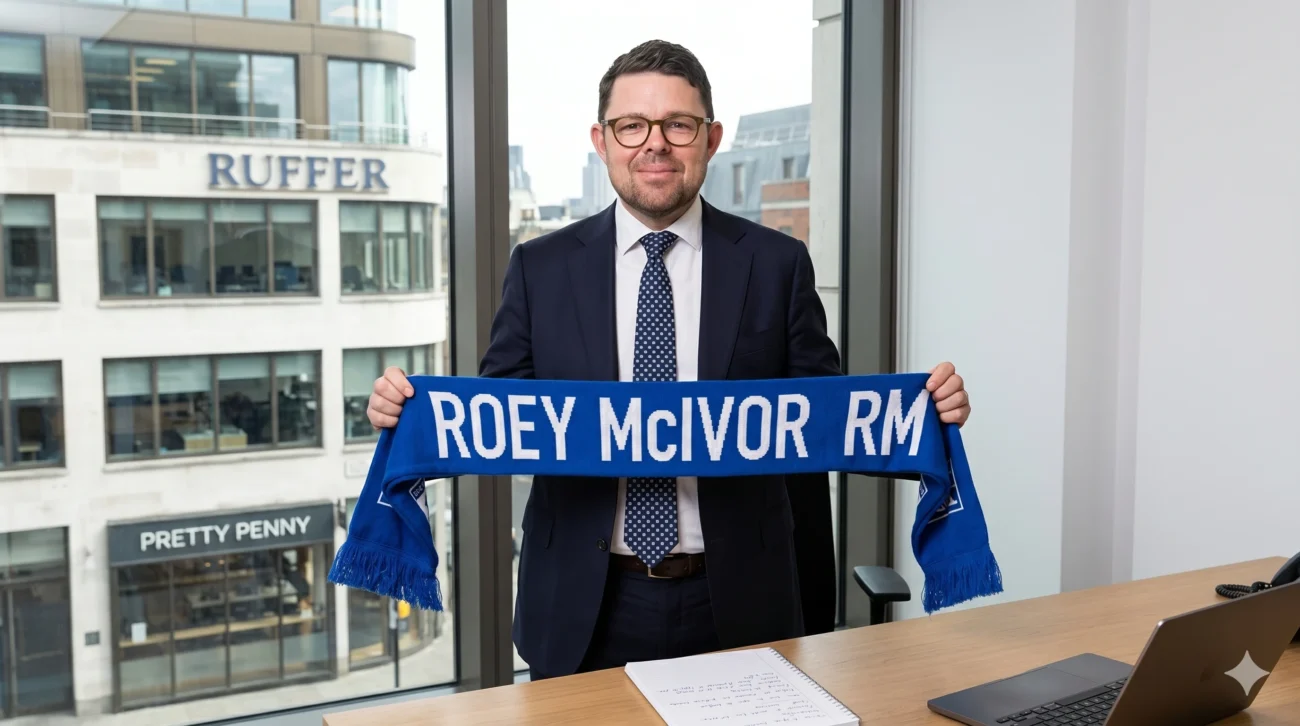
Rory McIvor is the kind of public figure who becomes familiar before he becomes famous. His name appears in investment commentary, finance podcasts, lifestyle coverage, and search results about Made in Chelsea alum Olivia Bentley, yet the person behind that trail is less tabloid character than careful communicator. He built his professional reputation in the world of investment management, first at Ruffer LLP, before moving toward a more public-facing role in financial education through Pretty Penny. That mix of City credibility, media instinct, and private-life curiosity has made him a figure readers want to understand with more care than gossip pages usually allow.
What makes McIvor interesting is not that he fits neatly into one category. He is not only an investment professional, not only a writer, and not only someone pulled into celebrity-adjacent attention through a reported relationship. His public story sits between old-fashioned finance and a newer generation of money education that wants to be stylish, accessible, and less intimidating. That tension gives his biography its shape: a young finance figure trying to explain markets in a voice built for readers who may not trust the old language of wealth.
Early Life and Family Background
Public information about Rory McIvor’s early life is limited, and that matters because some online profiles have filled the gaps too freely. The most reliable biographical accounts focus on his education and career rather than giving a detailed family history, hometown narrative, or childhood portrait. Several entertainment and lifestyle sites have described him as Irish, but the public record available through his professional work is stronger on his university background than on his upbringing. A careful biography has to respect that boundary rather than turn thin clues into a fully drawn childhood story.
What can be said with confidence is that McIvor’s later career reflects a strong interest in history, politics, markets, and public communication. Those themes do not appear by accident in his work; they run through the way he has explained financial events, central banks, bonds, and market stress. He has often approached investing through stories of institutions, policy choices, and past crises rather than through price charts alone. That habit suggests a mind shaped as much by historical comparison as by financial training.
His family life has not been widely documented in reliable public sources. Unlike many reality television figures or public entertainers, McIvor has not built a career out of personal exposure. Most of what readers know comes from professional bios, investment materials, and occasional media attention connected to his social circle. That restraint is part of why the public picture remains partial, even as search interest around his name has grown.
Education and First Ambitions
McIvor’s strongest documented education credential is his degree from the University of Edinburgh. Public biographical material tied to Ruffer states that he graduated with a first-class honours degree in history and politics before joining the investment firm in 2017. That academic combination is revealing because it sits close to the center of his later professional voice. History gave him a way to think in cycles, while politics gave him a way to read power, institutions, and policy decisions.
The University of Edinburgh background also places him in a tradition of graduates who move comfortably between public affairs, writing, finance, and media. McIvor’s route did not begin with a narrow technical identity as a trader or analyst. Instead, the public record suggests someone who entered finance with a humanities background and then learned to translate financial arguments for clients and broader audiences. That is a different path from the stereotype of the spreadsheet-driven City career.
Some online profiles claim additional academic details, including postgraduate study, but those claims should be treated cautiously unless confirmed by primary sources. The most dependable version of his education remains the Edinburgh degree cited in professional material. That restraint does not weaken the story; it sharpens it. McIvor’s public career can be understood clearly enough through the education and roles that are documented.
Joining Ruffer and Learning the Language of Markets
McIvor joined Ruffer LLP in 2017, a firm known for its cautious investment style and its emphasis on preserving capital during difficult markets. Ruffer is not a loud retail brokerage or a personality-driven finance brand. It has long appealed to clients who want thoughtful, defensive investment management and clear explanations of risk. For a young professional with a history and politics background, it was a setting where markets could be studied as human behavior, policy reaction, and institutional stress.
His early work at the firm was in the private client investment team, where he spent about four years. That experience matters because private client work is not only about investment theory. It requires explaining decisions to people whose money, goals, fears, and time horizons are real. A good private client professional has to understand both markets and temperament, especially during periods when headlines make investors nervous.
After that period, McIvor moved into investment communications and became one of the public voices associated with Ruffer’s market thinking. Professional bios have described him as leading Ruffer’s investment communications and as a member of the Chartered Institute for Securities & Investment. The title tells part of the story, but the work tells more. He helped turn investment views into articles, podcasts, webinars, and client-facing explanations that could travel beyond internal meetings.
From Private Client Work to Public Explanation
The transition from private client investment to communications was not a step away from finance so much as a move toward interpretation. McIvor’s public Ruffer work placed him in conversations about bonds, inflation, central banks, gold, silver, derivatives, the yen, and the mistakes of past economic policy. Those subjects can be dry in the wrong hands. His job was to make them legible without making them false.
One revealing example came in a piece about bonds, where McIvor recalled being asked in an interview, “What is a bond?” and failing to answer cleanly. The story works because it lowers the temperature around financial expertise. Instead of pretending that market knowledge arrives fully formed, it shows learning as a process of embarrassment, correction, and deeper curiosity. That kind of admission also helps explain why his later work could speak to people outside finance.
Ruffer Radio and other firm publications gave McIvor a platform that blended hosting, questioning, and framing. He was often positioned not as the only expert in the room, but as the person guiding the listener through what the experts were saying. In finance communication, that role is easy to undervalue. Yet for most readers and clients, the difference between confusion and understanding often lies in the quality of the person asking the questions.
Writing, Broadcasting, and Market Storytelling
McIvor’s public work at Ruffer showed a preference for financial storytelling rooted in history. He explored subjects such as the Barber boom of the early 1970s, a period of British economic expansion, inflation pressure, and policy misjudgment that still carries lessons for investors. That choice of topic says something about his method. He was interested not only in what markets were doing, but in how governments and investors repeat old patterns under new conditions.
His market commentary also appeared during a period when investors had to rethink many assumptions. The long era of low interest rates had distorted expectations about bonds, equities, inflation, and central bank power. For a communicator, that was demanding terrain because the old shorthand no longer worked. McIvor’s work sat inside that larger shift, explaining why assets that once seemed safe could behave differently in a changing rate cycle.
What separates good financial communication from marketing is honesty about uncertainty. McIvor’s best-documented professional setting, Ruffer, has often emphasized risk, protection, and the possibility that popular market beliefs can break. That background gave him a natural contrast with the faster, louder side of online finance. It also helps explain why his next public move, Pretty Penny, drew interest from people watching the future of financial education.
Pretty Penny and the Move Toward Financial Education
Pretty Penny is the clearest sign of Rory McIvor’s turn from institutional finance communication toward a broader public audience. The brand describes itself as a stock market education project designed to help people learn how to invest with more confidence and style. Its public language rejects both crypto hype and dull financial gatekeeping. That positioning is carefully chosen because it speaks to a generation that wants money education without being talked down to.
The Pretty Penny website has linked the project to Carmen Mundt, Rory McIvor, and Rory Wills. Its stated plan was to launch in summer 2025, and its tone suggests a brand built around design, cultural fluency, and accessible investment literacy. It is not presented as a traditional wealth manager, and it does not appear to be trying to mimic a textbook. Instead, it wants to make the stock market feel understandable to people who might otherwise avoid the subject.
That is a promising idea, but it also carries responsibility. Financial education can help people avoid bad decisions, but it can also encourage overconfidence if it slips into performance, hype, or oversimplified advice. McIvor’s Ruffer background gives Pretty Penny a layer of credibility, especially if the brand keeps clear boundaries between education and recommendation. The real test is whether it can stay useful without becoming another stylish wrapper around old financial temptations.
Public Image and Media Attention
For many readers, Rory McIvor first became a search term because of Olivia Bentley. Bentley, known to viewers of Made in Chelsea, has lived much more publicly than McIvor, and reporting in 2024 connected the two romantically. Lifestyle outlets described McIvor as a finance professional rather than a television personality, which helped create a contrast between Bentley’s reality-TV visibility and his quieter City background. That contrast made him more interesting to celebrity media than a standard boyfriend profile might have been.
The coverage should still be handled with care. Some reports relied on Instagram posts, social sightings, and second-hand descriptions, which can be useful but are not the same as full confirmation of a private relationship’s current status. Social media can show a moment, but it rarely gives a complete account of what is happening between two people. For that reason, the safest phrasing is that McIvor has been publicly linked to Bentley, not that every detail of the relationship is settled.
There is also evidence of later confusion in the entertainment press around other men named Rory connected to Bentley’s dating life. That confusion has made search results messier and increased the risk that readers conflate different people. McIvor’s own public identity should not be reduced to someone else’s relationship history. His career record exists independently, even if celebrity coverage helped bring his name to a wider audience.
Relationships and Private Life
McIvor’s private life remains only partly public, and that is how he appears to prefer it. He does not seem to have sought fame through personal disclosure, and most reliable information about him comes from work rather than family interviews or lifestyle features. The public link to Olivia Bentley brought more attention, but it did not turn him into a reality television cast member. There is a difference between being seen near fame and building a life around it.
There is no reliable public evidence that McIvor is married or has children. Claims about his family status, wealth, and personal arrangements should be treated cautiously unless they come from direct confirmation or dependable reporting. That is especially true because biography sites often recycle details without showing where they came from. A respectful profile should not pretend to know more about a private person’s home life than the record supports.
What is clear is that McIvor’s public image benefits from a kind of discretion that has become rarer. He appears comfortable speaking about markets, ideas, and education, but less eager to turn himself into the story. That restraint may be strategic, personal, or both. In either case, it has shaped the way readers encounter him: visible enough to be searched, private enough to remain partly unknown.
Business Interests, Income Sources, and Net Worth
Rory McIvor’s known income sources are tied to his finance career, communications work, and entrepreneurial activity through Pretty Penny. At Ruffer, he held roles connected to private client investment and markets communications, which would have placed him in a serious professional tier within the investment world. Pretty Penny adds a different possible income path, though the brand’s commercial model has not been fully disclosed in public materials. It may develop through courses, media, partnerships, events, or other education products, but those details should not be assumed before the company makes them clear.
There is no credible public figure for McIvor’s personal net worth. Some websites publish estimates, but they do not provide the kind of evidence required to treat those numbers as reliable. Unlike public-company executives, elected officials, or major celebrities with court filings and public contracts, McIvor does not have a widely documented financial disclosure record. Any exact net worth claim should be viewed as speculative unless supported by strong sourcing.
The better way to understand his financial position is through career category rather than invented numbers. He has worked in investment management, held a senior communications role at a respected firm, and moved into financial education entrepreneurship. Those facts suggest professional success, but they do not justify a precise wealth estimate. In biography writing, saying “unknown” is often more honest than dressing a guess in confident language.
Industry Standing and Public Contribution
McIvor’s standing is strongest in the area of financial communication. He is not best known as a celebrity investor, a hedge fund founder, or a television pundit. His documented contribution lies in helping explain market thinking in ways that clients and interested readers can follow. That may sound modest, but in finance, explanation is part of trust.
Ruffer’s style of public communication is serious, historically aware, and often skeptical of market consensus. McIvor’s work there placed him inside a firm culture that values caution and argument over easy optimism. For readers trying to understand his professional identity, that context matters. It suggests that his voice was shaped in an environment where the downside case, not just the sales case, had to be taken seriously.
Pretty Penny may broaden that contribution if it succeeds. Financial literacy remains a real problem, especially among people who are expected to manage pensions, savings, investments, and risk without much formal education. A project that teaches investing clearly can do meaningful public work, provided it is honest about losses, time horizons, fees, and uncertainty. McIvor’s next reputation will likely depend on how well Pretty Penny meets that standard.
Common Misunderstandings About Rory McIvor
One misunderstanding is that Rory McIvor is famous only because of Olivia Bentley. That reading is too narrow because it ignores his years in investment management and communications before the entertainment press noticed him. The celebrity connection may have expanded search interest, but it did not create the substance of his professional biography. His documented work at Ruffer and his role in Pretty Penny are the more durable parts of the story.
Another misunderstanding is that every search result for Rory McIvor points to the same person. There is also a Rory K. McIvor in Australia, a barrister associated with family law and the Victorian Bar. That is a separate professional with a different career, country, and public record. Search users should be careful not to mix the UK finance figure with the Australian legal practitioner.
A third misunderstanding involves the certainty of personal details. Online profiles often repeat age, net worth, school history, relationship status, and future plans as if all of them were equally verified. They are not. The strongest available record supports his Edinburgh education, Ruffer career, communications work, and Pretty Penny connection, while several private-life details remain unconfirmed.
Where Rory McIvor Is Now
As of the most recent public information, McIvor is associated with Pretty Penny and with the move toward consumer financial education. Ruffer-linked professional pages describe him as a former director of markets and communications, while Pretty Penny’s public site places him among the figures behind the brand. That suggests a shift from institutional investment communication to a more entrepreneurial, audience-facing project. It is a natural progression for someone whose public work has long involved explaining markets.
The timing is interesting because financial education is having a crowded moment. Social media has made investing more visible, but not always more understandable. Many people now encounter market ideas through clips, newsletters, influencers, and friend-group conversations before they ever speak with a qualified adviser. Pretty Penny is entering that world with the promise of taste, clarity, and stock market literacy.
McIvor’s current public challenge is credibility at scale. In a firm setting, trust comes partly from institutional reputation and client relationships. In a public education brand, trust has to be earned repeatedly through accuracy, tone, transparency, and restraint. If Pretty Penny can do that, McIvor may become better known not as a finance insider who brushed against celebrity culture, but as one of the people trying to make investing less alienating.
Frequently Asked Questions
Who is Rory McIvor?
Rory McIvor is a finance professional, writer, and communications figure associated with Ruffer LLP and the financial education brand Pretty Penny. He joined Ruffer in 2017 after graduating from the University of Edinburgh with a first-class honours degree in history and politics. His public profile is built around investment communication, market explanation, and a newer move into stock market education.
What is Rory McIvor known for?
He is known for working at Ruffer, where he moved from private client investment into markets and investment communications. He has appeared in Ruffer articles, webinars, and podcasts discussing market themes such as bonds, inflation, central banks, precious metals, derivatives, and economic history. Outside finance circles, he has also drawn attention through reports linking him to Olivia Bentley.
What is Pretty Penny?
Pretty Penny is a financial education brand that presents itself as a stylish and accessible way to learn about the stock market. Its public website says it aims to help people make smarter investment choices and positions itself against both crypto hype and boring finance content. Rory McIvor is one of the names publicly connected with the project, alongside Carmen Mundt and Rory Wills.
Is Rory McIvor married?
There is no reliable public evidence that Rory McIvor is married. Public attention around his personal life has centered mostly on reports that linked him to Olivia Bentley in 2024. Because he has not made a broad public identity out of his private life, details about marriage, children, or family arrangements should not be assumed.
Is Rory McIvor Olivia Bentley’s boyfriend?
Several lifestyle and entertainment outlets reported that Rory McIvor was romantically linked to Olivia Bentley, best known from Made in Chelsea. Those reports were based largely on public sightings and social media context, so current relationship status should be handled carefully unless directly confirmed. The safest account is that he has been publicly linked to Bentley, not that every detail of their relationship is publicly settled.
What is Rory McIvor’s net worth?
Rory McIvor’s net worth has not been reliably confirmed. Some biography-style websites publish estimates, but they do not provide strong sourcing or official records. His known professional background suggests success in finance and communications, but no precise personal wealth figure should be treated as fact.
Is Rory McIvor the Australian barrister?
No, the Rory McIvor associated with Ruffer and Pretty Penny should not be confused with Rory K. McIvor, an Australian barrister who works in family law. They are separate public professionals with different careers and locations. This distinction matters because search engines can surface both names in the same results.
Read Also: Grace Hayden Age, Biography, Career and Family Life
Conclusion
Rory McIvor’s story is still being written in public, but the outline is already clear. He moved from a history and politics education into investment management, learned the discipline of private client work, and then built a voice in financial communication. That route gave him a rare blend of market knowledge and editorial instinct.
His wider visibility has come partly from personal-life coverage, but that is not the most interesting part of his biography. The more meaningful story is his shift toward Pretty Penny and the question of how serious finance can be made more approachable without becoming shallow. That is a harder task than it looks, and it will require both style and discipline.
For now, McIvor stands at the edge of a larger change in how people learn about money. He belongs to a generation that understands that investing can no longer be explained only in client letters and private meetings. If his next chapter works, it will be because he helps readers feel less excluded from finance while still respecting how much they need to learn.
